







Ask three people what an app costs and you will get three answers that sound nothing alike. A founder says fifty thousand dollars. An agency says two hundred thousand. A freelancer on a marketplace says fifteen. The frustrating part is that all three can be telling the truth, because the word “app” covers products that share almost nothing except the icon on a home screen. Before you speak to any Mobile App Development Company about budgets, it helps to understand what you are buying. What follows is an honest walkthrough of how mobile app development actually runs, stage by stage, and where the money goes at each one.
What You Are Actually Paying For
Most people imagine development as coding, and coding is maybe half the job. The other half is judgment, interface work, server infrastructure and the slow grind of quality control. A typical app today leans on more than thirty external services for things like maps, payments, push notifications, authentication and analytics. Every one of those connections has to be configured, secured, monitored and eventually updated when the provider changes something. Underneath that sits a backend, a database, internal tooling for your own staff and a release process answering to two app stores with different rules. When a quote feels inflated, it is usually because the person reading it priced the screens they could see and not the machinery holding them up.
Discovery Is Where Projects Are Won or Lost
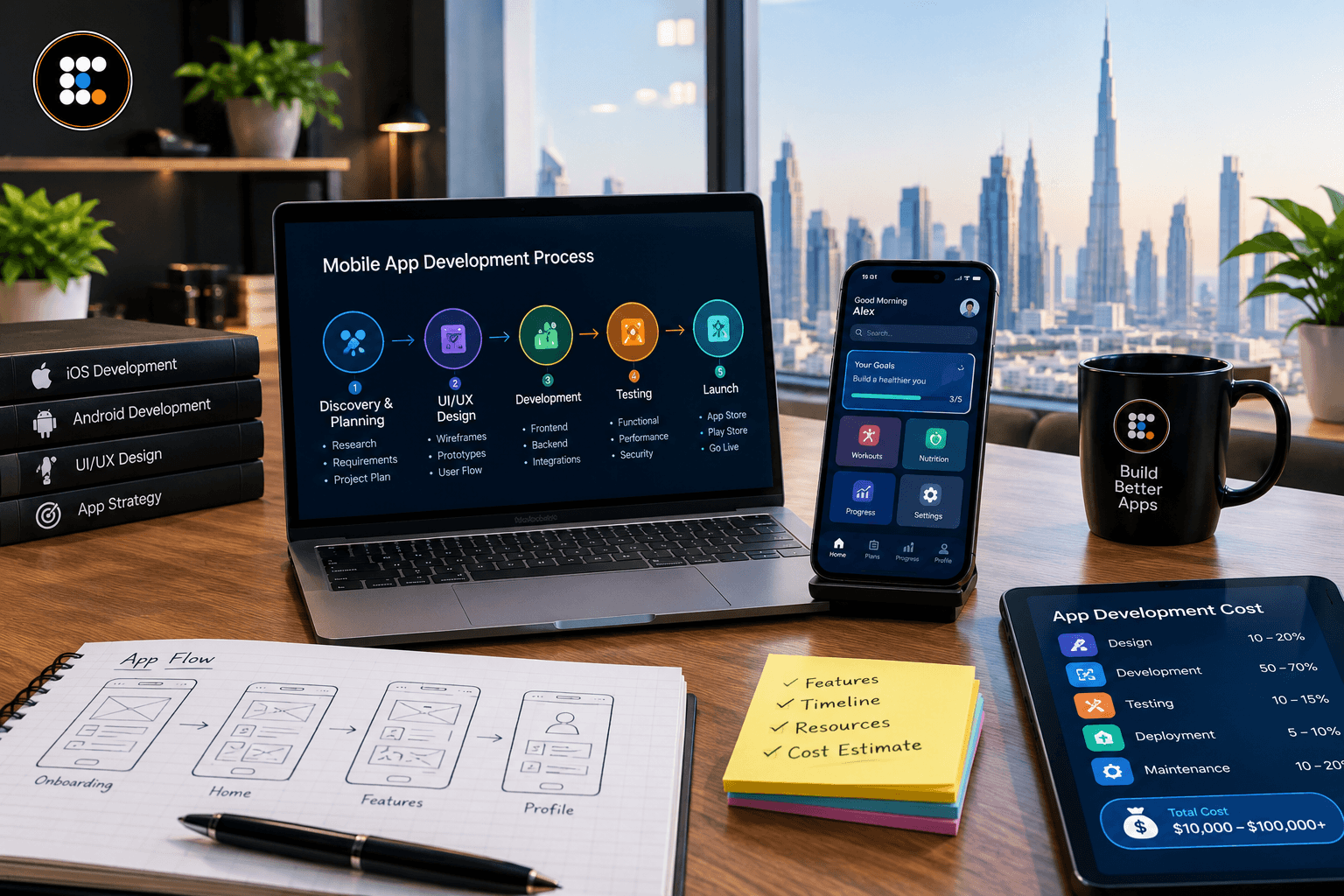
Discovery usually runs two to four weeks and takes ten to fifteen percent of the budget. The team works out who the app is for, which single problem version one solves, and just as importantly, what is staying out. You should walk away with user flows, a ranked feature list, an architecture outline and an estimate tied directly to that list rather than a vague total. Clients often ask to skip this stage to save money, and it rarely works out. Scope creep hits more than seventy percent of software projects and pushes budgets over by around twenty seven percent on average, and nearly all of that traces back to decisions nobody wrote down at the beginning.
Design Does More Than Make It Look Good
Design takes four to nine weeks and fifteen to twenty five percent of the budget, and it is the phase clients most often try to compress. The work moves from rough wireframes to clickable prototypes to a full visual system that accounts for loading states, errors, empty screens and the differences between iOS and Android conventions. The business case here is not aesthetic. Global day 30 retention sits at roughly seven percent, which means more than nine in ten people who install an app have stopped opening it within a month. Confusing onboarding and unclear value are what drive them away, and an hour spent fixing that in a prototype costs a fraction of fixing it in shipped code.
Development Is Longer Than Anyone Expects
This is the long stretch, usually eight to twenty four weeks, and it absorbs forty to fifty five percent of the total spend. Backend, client application and integrations progress in parallel, which is why good mobile app developers work in two week sprints and hand you a running build at the end of each one. If you are only receiving written status updates, you have no real way to judge progress. Expect the backend to take longer than you budgeted, particularly if the app touches payments, user generated content or anything real time. Tying payments to demonstrable milestones rather than a calendar protects you far better than a lump sum ever will.
Testing and the App Store Reality Check
Quality assurance runs three to six weeks and takes another ten to fifteen percent, covering functional testing, device fragmentation, performance, security and accessibility. Then comes submission, and this is where unprepared teams quietly lose a month. Apple reviewed 7.77 million submissions in 2024 and rejected roughly 1.93 million of them, a rate close to twenty five percent. More than forty percent of unresolved review issues come down to app completeness, meaning crashes, placeholder text or a demo login that does not work. The other common rejection is minimum functionality, which catches anything that behaves like a website in a wrapper. Experienced teams prepare for review during the build, not the week before launch.
Launch Day Is the Start, Not the Finish
Something worth internalising early is that the budget does not stop when the app goes live. Both platforms ship major operating system updates every year. SDKs get deprecated, certificates expire, and your analytics will show you within a fortnight that users do at least three things nobody on the team predicted. Agree on support terms before launch, including response times for critical bugs and a monthly allowance for fixes and small changes. The first ninety days produce the most valuable product data you will ever get your hands on, and teams able to act on it quickly tend to pull well ahead of those waiting for the next funding round to make a decision.
Native, Cross Platform, or Something in Between
Cross platform has quietly become the default for most business applications, and the economics explain why. Building in Flutter or React Native cuts initial development cost by thirty to fifty percent against two separate native builds, since one codebase serves both platforms. Flutter holds around forty six percent of the cross platform market and React Native sits near thirty five to thirty eight percent, with the two together accounting for more than eighty percent of it. Performance stopped being the deciding factor some time ago, as both now reach ninety five to ninety eight percent of native in ordinary use. Native still earns its place for heavy graphics, deep hardware access and on device machine learning, so when you brief an android app development company, ask which framework they reach for by default and why.
What It Costs in 2026
A simple single platform MVP lands between fifteen and fifty thousand dollars over three to four months. A mid complexity business app with logins, payments, notifications and an admin panel runs sixty to one hundred fifty thousand over five to eight months. Complex and enterprise builds begin near one hundred fifty thousand and regularly pass half a million. Clutch puts the average app project around ninety thousand dollars, with most falling between ten and fifty thousand. Geography moves the figure more than the feature list does. Senior developers bill one hundred thirty to one hundred ninety dollars hourly in the United States, fifty five to eighty five across Eastern Europe and Latin America, and twenty six to forty two for mid level talent in South Asia. Dubai agencies sit near a thirty seven dollar median.
The Costs Nobody Puts in the First Budget
Four things get left out of almost every initial estimate. Maintenance consumes fifteen to twenty percent of build cost each year, and year one often reaches twenty five to thirty five percent once real usage exposes what testing missed. Third party services bill per transaction, so payments, SMS and AI calls grow with your success instead of staying flat. Store membership and hosting form a steady floor, with Apple charging ninety nine dollars annually and cloud costs starting near one hundred to three hundred a month. Then there is user acquisition, which frequently exceeds the build itself. At Fixels Media these go into the first year projection from the outset rather than arriving as unpleasant surprises in month four.
Questions Worth Asking Before You Sign
Ask for a scope document with features listed individually and assumptions written out, not a single number on letterhead. Ask who is actually assigned to your project and whether they are employees or subcontracted. Ask for a live app you can download from a store rather than a rendered case study. Ask what happens if the timeline slips, and make sure the answer appears in the contract. Ask who owns the code, the repositories and the store accounts, because a surprising number of businesses only discover after launch that their listing lives under an agency login. For region specific guidance, How to Choose the Right App Development Company in Dubai covers local compliance and vendor vetting properly.
Conclusion
The number that matters is not the quote you receive in week one. It is what the product costs you across the first eighteen months, once maintenance, integrations, hosting and the changes real users force on you have all landed. Businesses that treat mobile app development as five funded stages with distinct risks tend to end up roughly where they planned. Businesses that treat it as one line item almost never do. Protect discovery, give design the time it needs, insist on working builds throughout development, and budget for a year rather than a launch. Above all, favour mobile app developers who are willing to argue for a smaller version one, because the team that tells you which features to cut is usually the team that has shipped enough products to know what actually survives contact with users.