







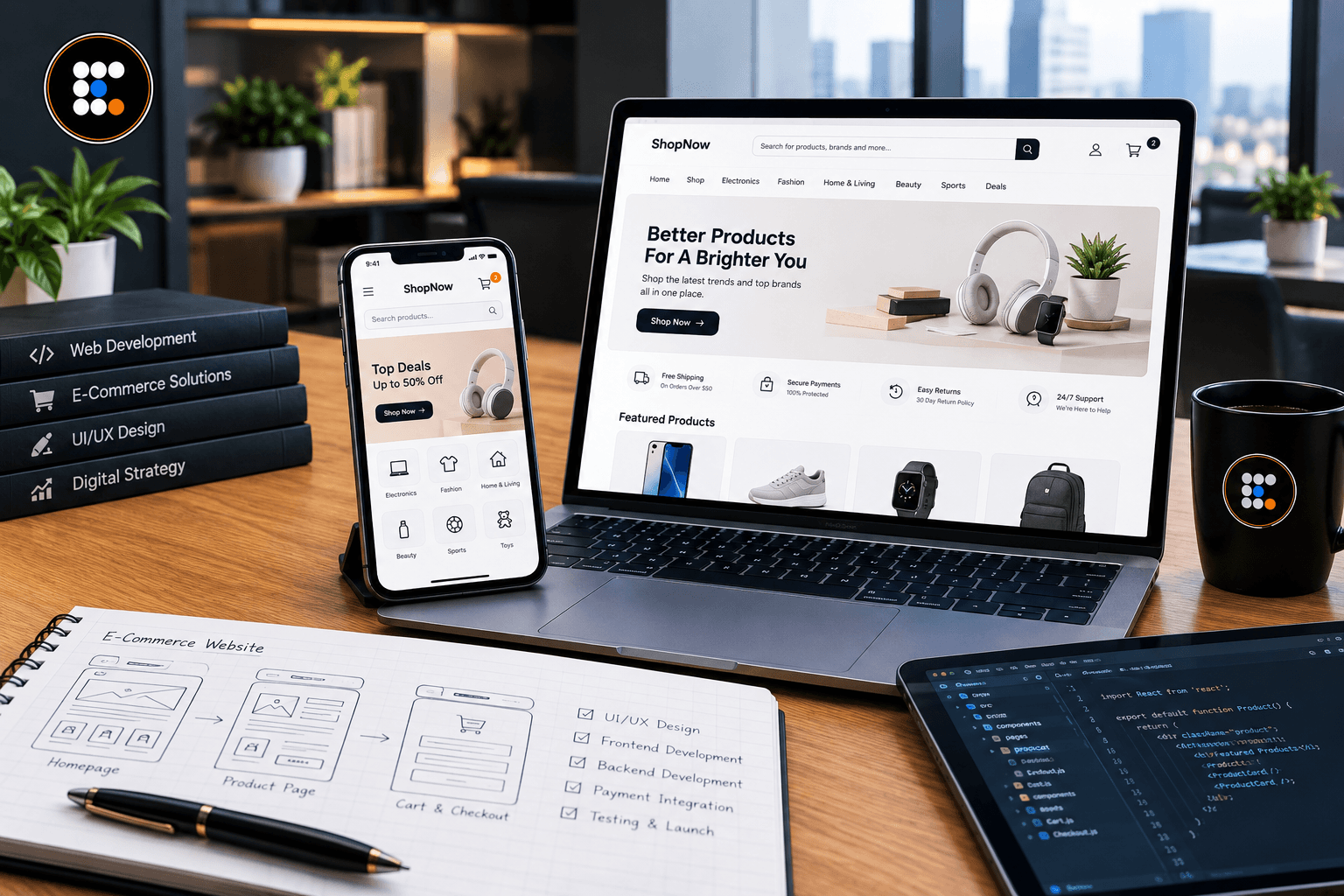
Ask ten business owners what they are buying when they hire an ecommerce website development company Dubai businesses rely on, and most will describe a storefront. Pages, product photos, a shopping cart, a checkout button. That description covers perhaps a quarter of the actual work. The rest sits underneath the surface in payment routing, tax compliance, inventory synchronisation, performance budgets and bilingual architecture, and it is the part that determines whether a store makes money or quietly leaks it. Understanding that gap is the first step to picking an ecommerce solutions company that will actually move your revenue. This article breaks down what the job genuinely involves, stage by stage, so you know what you are paying for.
Why the Job Is Misunderstood
The confusion is understandable, because the only part a client sees is the visual layer. But the economics tell a different story. UAE cart abandonment runs at 78.0 to 78.5%, against an add-to-cart rate of just 11.5 to 12.0%. Almost four out of five shoppers who reach a cart walk away, and very few of them leave because the homepage was unattractive. They leave because a payment method was missing, a delivery promise was vague, a page stalled, or the Arabic version felt machine-translated. A competent ecommerce web development company treats design as one input into a commercial system rather than the deliverable itself. That distinction shows up in the brief, the questions asked during discovery, and ultimately in the revenue the store produces.
The Work Before a Single Page Is Designed
Commercial Discovery and Catalogue Planning
Serious builds begin with the catalogue, not the mood board. The team maps product types, variants, bundles, pricing tiers and stock behaviour, because those structures dictate everything downstream. A fashion brand with size and colour swatches needs a different data model than a furniture retailer with lead times and delivery scheduling. This stage also surfaces the awkward questions early: who updates inventory, where does product data live today, and what happens when an item sells out mid-checkout. Skipping discovery is how projects end up rebuilt six months after launch.
Platform Selection and Technical Fit
Platform choice is a commercial decision disguised as a technical one. A basic Shopify store typically runs AED 15,000 to AED 30,000 and launches in two to four weeks, while a custom WooCommerce build ranges from AED 25,000 to AED 100,000 across four to eight weeks, with a bilingual Arabic and English version adding another two to four weeks. The right answer depends on catalogue size, integration depth and how much control you need over checkout. Our guide on How to Choose the Right E-Commerce Platform for Your Business in Dubai walks through that comparison in detail. A good partner will recommend the cheaper platform when it fits, and explain clearly when it does not.
Building the Storefront: Design, UX and Conversion Architecture
Information Architecture and Product Discovery
Most stores lose customers before the cart, in navigation and search. Category structures, filter logic, faceted search and collection templates all determine whether a visitor finds the right product in two clicks or gives up in five. This is why experienced teams spend time on taxonomy that clients rarely notice. Electronics alone accounts for 34% of UAE e-commerce revenue, a category where specification filtering is the difference between a sale and a bounce. The design work here is structural, not decorative.
Checkout Design and Cart Abandonment
Checkout is engineered against known failure points: forced account creation, hidden shipping costs, too many fields, and unclear delivery timelines. Small interventions matter, and sticky add-to-cart bars on mobile lift add-to-cart rate by 14% with no change to pricing or creative. With roughly 74% of e-commerce traffic now arriving on mobile and mobile conversion still trailing desktop by 40 to 60% on most stores, the mobile checkout flow deserves more attention than the desktop one, which is the reverse of how most agencies allocate their time.
The Engineering Layer Most Clients Never See
Payments, Currencies and Local Gateways
Payment configuration is where generic builds quietly fail in this region. Digital wallets lead UAE e-commerce at 35% of volume and are projected to reach 40% by 2030, while wallets and cards together cover 77% of online transaction volume. Cash on delivery remains roughly 25 to 30% of orders, particularly outside Dubai and among first-time buyers. Buy now, pay later is the fastest-growing method, and merchants typically see over 30% higher average order values once Tabby is enabled. Getting this stack right means integrating a gateway such as PayTabs, Telr, Checkout.com or Tap, adding wallet support, enabling BNPL, and configuring COD with verification rules so unverified orders are not shipped blindly.
Inventory, ERP and Order Management Integrations
Once a business has a warehouse, a POS or an accounting system, the store stops being standalone. Integration work usually runs through a middleware layer that syncs inventory inward and pushes orders and invoices outward, asynchronously, so the storefront never waits on an ERP response. Connections to Oracle, SAP, Microsoft Dynamics or a custom system each carry their own quirks, and in the Dubai market a single third-party integration commonly costs AED 5,000 to AED 12,000. Logistics APIs for Aramex, Fetchr or Quiqup sit in the same layer, feeding live tracking and delivery estimates back to the customer.
Performance, Core Web Vitals and Mobile Speed
Speed is revenue. Every one second of LCP delay drops conversion by 11.4% on the median site, and 53% of mobile users abandon pages that take longer than three seconds. Yet only 33% of sites pass all three Core Web Vitals, and among Shopify stores the mobile pass rate is 33% against 58% on desktop. Development teams manage this with image optimisation, caching, CDN configuration, deferred scripts and strict app discipline, because every installed app adds weight.
What an E-Commerce Website Development Company in Dubai Handles Differently
Local requirements change the build meaningfully. Arabic is not a translation task, it is an engineering one: navigation moves to the right, banners flip, carousels scroll the opposite way, and typography must support Arabic script without breaking the layout. Bilingual stores also need language toggles synchronised through metafields and localised URLs, plus separate keyword targeting for Arabic and English search. Trust is regionally specific too, since domestic websites account for around 73% of UAE online sales against 27% for foreign sites, which means local signals like an AED display price, a UAE address and recognisable couriers materially affect conversion. This is the practical difference between ecommerce website development companies in dubai that understand the market and offshore teams applying a template.
Compliance, Security and Trust Infrastructure
Compliance is now a build requirement rather than an afterthought. The UAE e-invoicing mandate takes effect in July 2026 for B2B and B2G transactions, with B2C currently out of scope, and phases continue through to October 2027. It sits on Federal Decree-Law No. 16 and No. 17 of 2024, with Cabinet Decision 100 of 2025 amending the VAT Executive Regulations from 29 September 2025, and invoices exchange through the Open Peppol network via an accredited service provider. For store owners this means VAT-correct invoicing, compliant archiving and an order system capable of producing structured invoice data. Add PCI-compliant payment handling, SSL, and clear refund and delivery policies, and the trust layer is complete.
Launch Is the Midpoint, Not the Finish Line
Go-live involves data migration, redirect mapping to protect existing SEO equity, staging QA across both language versions, payment sandbox testing and a rollback plan. After launch, the work shifts to optimisation: analysing drop-off points, testing checkout variations, improving page speed and expanding content. Against a median e-commerce conversion benchmark of 2.35%, incremental gains compound quickly. If you want a fuller view of that ongoing scope, our breakdown of What Does an E-Commerce Solutions Company in Dubai Actually Do? covers the retainer side in depth.
How to Tell a Real Development Partner from a Template Shop
Ask three questions. First, which payment methods will you enable and why, since an answer that omits wallets, BNPL or COD reveals unfamiliarity with the market. Second, how will the Arabic version be handled, because anyone who says the theme supports it has not done RTL properly. Third, what happens after launch, as proposals that end at go-live usually mean no one owns performance. Vague answers on hosting, code ownership or integration cost are reliable warning signs.
Final Thoughts
An online store is an operating system for a retail business, which is why the real work lives in payments, compliance, integrations and speed rather than in the visual layer alone. Before you commit a budget, ask any shortlisted team to walk you through their payment stack, their Arabic approach and their post-launch plan. Fixels Media builds this way, and it is a reasonable standard to hold any partner to. The agencies that can answer those three questions clearly are usually the ones whose stores are still converting a year later.