







Every business relies on information to manage sales, track expenses, monitor inventory, and make important decisions. However, when different departments use disconnected systems, even simple tasks can become complicated. Employees spend additional time updating records, preparing reports, and correcting information that should already be available. This is where Enterprise Resource Planning software becomes relevant. Understanding the ERP meaning helps business owners recognize how integrated systems can improve daily operations and support growth. For companies considering a customized business management solution, Fixels Media, an ERP software development company in Dubai, offers ERP development, integration, and implementation services. Before investing, it is important to understand what ERP actually does, how it works, and whether your business genuinely needs it.
What Does ERP Stand For? ERP Full Form Explained
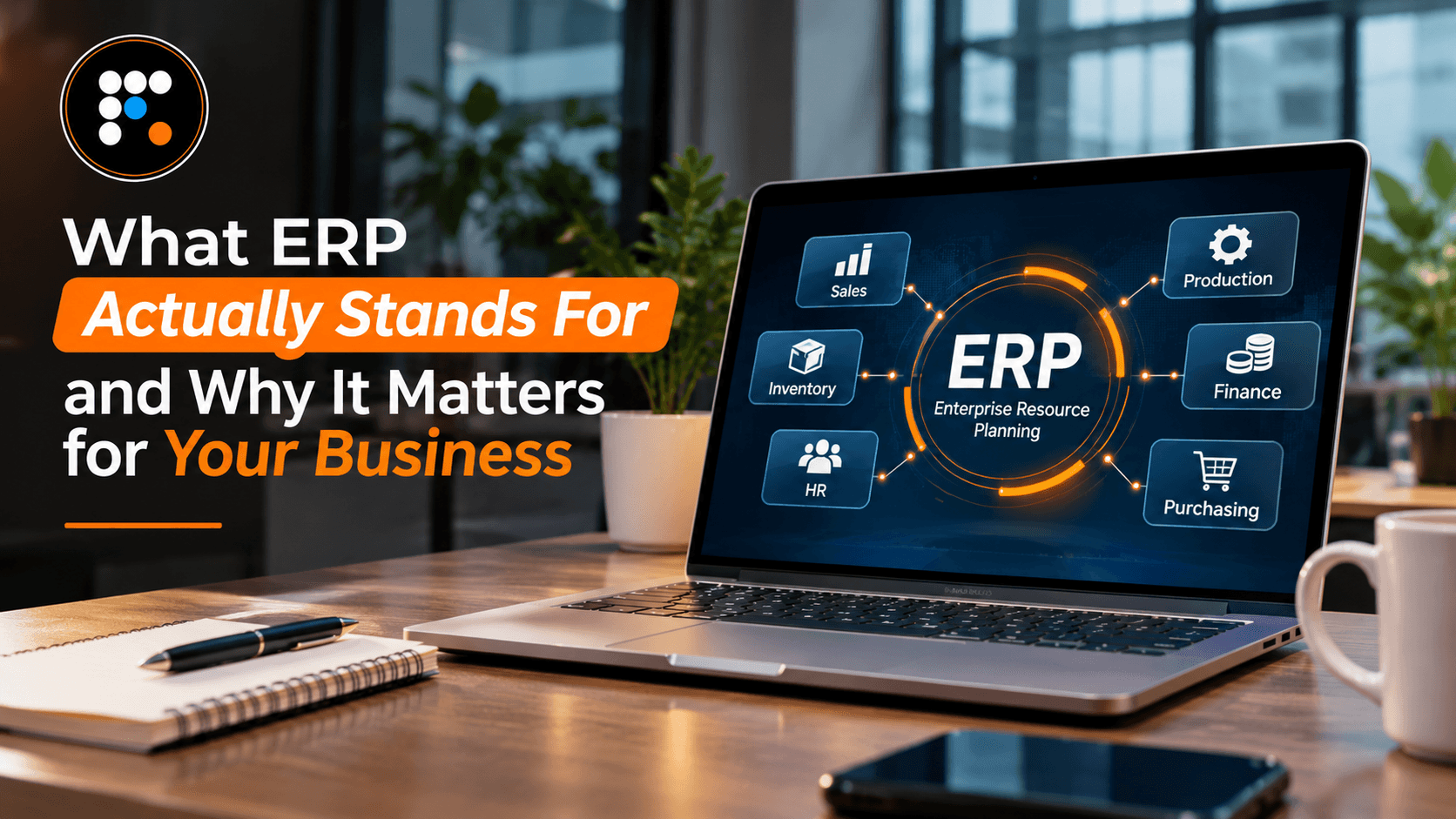
The ERP full form is Enterprise Resource Planning. It refers to software designed to connect important business functions within a shared system. Instead of managing accounting, inventory, purchasing, sales, and employee information through completely separate applications, businesses can coordinate these activities using integrated modules. The term originated from earlier manufacturing and materials planning systems before expanding into broader business management software. Today, ERP is used across industries, including retail, distribution, manufacturing, and professional services. Its primary purpose is to improve how information moves between departments and provide a more consistent view of operations. Understanding this distinction is important because ERP is not simply accounting software with additional features. It is a system designed to connect multiple business processes.
How Does an ERP System Actually Work?
An ERP system works by allowing different departments to use shared business information through connected applications. Consider a distribution company receiving a customer order. The sales team records the transaction, the inventory module checks product availability, and the warehouse receives the information needed to prepare the order. Depending on the configured workflow, the accounting module can then generate an invoice and update the relevant financial records. Management can review these activities through reports without collecting information from separate departments. This integration reduces repetitive data entry and improves visibility across operations. However, the effectiveness of these processes depends on accurate records, appropriate system configuration, and employees understanding their responsibilities.
What Are the Main Components and Modules of ERP Software?
ERP software consists of modules designed to manage different business functions. Finance and accounting modules support invoicing, payments, and financial reporting. Inventory applications track stock movements and warehouse activities, while sales and customer management modules organize orders, customer records, and sales opportunities. Other modules may cover procurement, manufacturing, human resources, project management, and business analytics. These applications can share information while allowing employees to access the functions relevant to their roles. Some people searching for ERP information use phrases such as ERP bits, but this is not a standard industry term. ERP functionality is more accurately described through modules, integrations, and business workflows. Companies should select the components they actually need rather than implement every available feature.
How ERP Connects Different Business Departments
One of the biggest challenges businesses face is maintaining consistent information across departments. Sales employees may use one application, accounting staff another, and warehouse teams an entirely different system. When these applications do not communicate effectively, information must be transferred manually, creating opportunities for errors and delays. ERP addresses this problem by connecting relevant workflows and records. For example, purchasing information can support inventory planning, while completed sales transactions can contribute to financial reporting. Employees can work with more consistent information without repeatedly requesting updates from other teams. However, integration does not automatically guarantee accuracy. Businesses must establish suitable permissions, maintain reliable records, and configure processes correctly.
What Are the Key Benefits of ERP for Modern Businesses?
A properly implemented ERP system can offer several operational advantages. One benefit is improved data consistency because related departments can work with shared information instead of maintaining duplicate records. Automated workflows may reduce repetitive administrative tasks, while integrated reporting can make financial and operational information easier to access. ERP can also support inventory visibility, purchasing coordination, and more efficient communication between departments. These improvements may help management identify operational problems and make better informed decisions. However, the benefits are not automatic. Poor configuration, inaccurate data, or inadequate employee training can limit the system's effectiveness. Businesses should establish measurable objectives before implementation rather than assume that purchasing ERP software will immediately increase profitability.
ERP vs Traditional Business Software: What's the Difference?
Traditional business software often focuses on individual functions. A company might use one application for accounting, another for inventory, and a separate platform for customer management. These tools can work effectively, particularly when business processes are relatively simple. Problems arise when employees must manually transfer information between applications or reconcile inconsistent records. ERP takes a more integrated approach by connecting related activities within a coordinated environment. This makes it possible for information recorded in one department to support processes elsewhere. However, separate applications are not necessarily inferior. Some businesses can achieve satisfactory integration using their existing tools. The appropriate choice depends on operational complexity, reporting requirements, and the cost of maintaining different systems.
Does Every Small or Growing Business Need ERP?
Not every growing business needs a comprehensive ERP platform. A small company with straightforward operations may manage effectively through accounting software and a limited number of connected applications. However, businesses with multiple departments, warehouses, or increasingly complicated workflows may benefit from greater integration. The decision should depend on operational requirements rather than employee numbers alone. Before investing, owners should evaluate how much time employees spend on manual activities, how frequently reporting errors occur, and whether existing applications can support future requirements. For a more detailed assessment, read Is ERP Software Worth It for Small and Mid-Sized UAE Businesses?. Understanding these considerations helps businesses avoid investing in unnecessary functionality while identifying situations where ERP could provide meaningful value.
Cloud ERP vs On Premise ERP: Understanding Your Options
Businesses generally have different deployment options when implementing ERP software. Cloud ERP operates through hosted infrastructure and is commonly accessed using an internet connection. It may reduce the need to maintain local servers, although ongoing subscription charges and service arrangements must be considered. On premise ERP operates on infrastructure managed by the organization or its appointed technical team. This arrangement can provide different levels of control but may require additional investment in hardware, maintenance, and internal expertise. Some businesses also use hybrid deployments combining both approaches. Neither option automatically offers better security or lower costs. Companies should evaluate accessibility, data ownership, backups, maintenance responsibilities, and technical requirements before selecting a deployment model.
How Much Does ERP Software Cost to Implement?
The cost of implementing ERP depends on the selected software, number of users, required modules, and complexity of existing business processes. Subscription or licensing fees represent only part of the total investment. Businesses may also need to pay for requirements analysis, configuration, customization, data migration, integrations, testing, and employee training. Additional expenses can arise from hosting, technical maintenance, future upgrades, and ongoing support. A company with straightforward requirements may need a relatively limited implementation, while one with complex workflows may require substantial development. Business owners should request detailed quotations explaining which activities are included and which involve separate charges. Evaluating the total cost of ownership provides a more reliable basis for deciding whether ERP is financially practical.
Signs Your Business Has Outgrown Its Existing Software
Businesses often recognize the need for better systems when existing applications begin creating recurring operational problems. Common warning signs include inconsistent inventory records, delayed financial reporting, repeated data entry, and difficulty accessing information across departments. Employees may depend heavily on spreadsheets or spend considerable time reconciling records between applications. As operations expand, these manual processes can become increasingly difficult to maintain. Another warning sign is the growing number of temporary technical solutions required to keep existing systems working together. Businesses experiencing these difficulties may benefit from reviewing Signs Your Business Has Outgrown Its Current Tech Setup. Identifying these problems early helps management determine whether integration improvements or a complete ERP implementation would be more appropriate.
How to Choose the Right ERP Solution for Your Business
Selecting an ERP solution should begin with a clear understanding of business requirements. Identify which departments need better integration, which processes create the most difficulties, and what information management needs for decision making. Compare available functionality, customization requirements, deployment options, and compatibility with existing applications. Businesses should also evaluate the implementation partner's technical experience, migration capabilities, and support arrangements. For UAE companies, local accounting requirements deserve particular attention. The standard VAT rate is 5%, and the country's phased electronic invoicing implementation begins in 2027 for businesses within scope. Organizations should confirm whether their proposed ERP configuration supports applicable tax reporting and required electronic invoicing integrations. Choosing based on actual operational requirements is more useful than selecting software simply because it offers numerous features.
Conclusion:
Understanding the ERP meaning helps businesses recognize that Enterprise Resource Planning is about connecting operations rather than simply replacing existing software. An integrated system can improve information consistency, support reporting, and reduce unnecessary manual work when implemented correctly. However, ERP is not essential for every company, and its benefits depend on business requirements, accurate data, employee adoption, and proper configuration. Organizations should carefully assess their existing challenges, compare available solutions, and understand implementation costs before committing to a new platform. Whether a business is managing simple operations or coordinating several departments, the right technology investment should solve genuine problems and support practical long term objectives.