





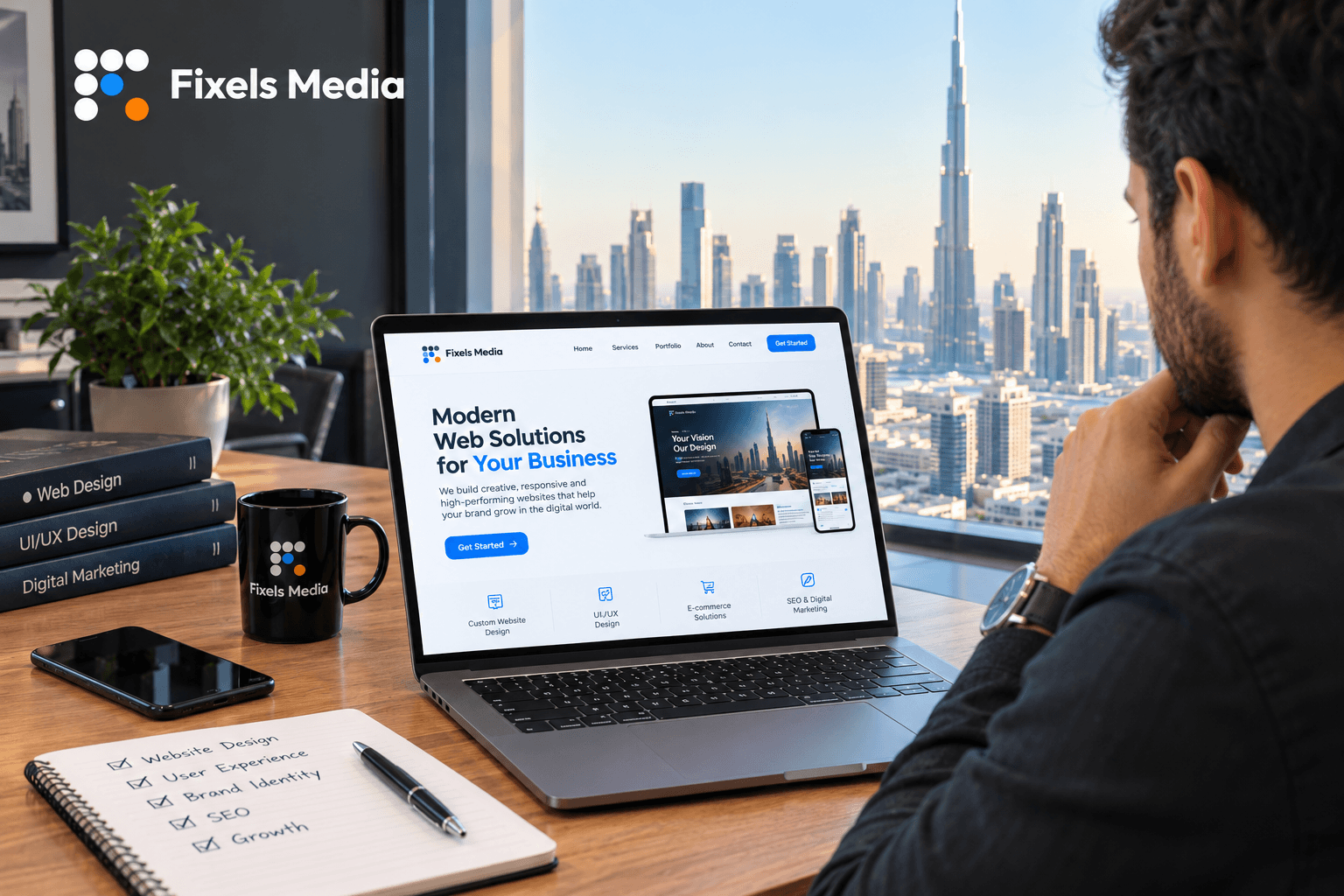
Hiring a web design company in Dubai looks simple until you start collecting quotes. One agency asks for AED 3,500 and promises delivery in a week. Another asks for AED 60,000 and wants a discovery workshop before anyone touches a wireframe. Both are selling something described as a website, yet the gap between them is enormous. Most business owners have no reliable way to judge which quote reflects genuine capability and which reflects a template with a new logo dropped into it, which is why it pays to understand how a serious Web Development Company actually scopes and prices work. This guide breaks down how to evaluate agencies properly, what separates strong studios from average ones here, and the questions that reveal the truth before you sign.
Why Dubai's Market Raises the Bar for Web Design
Dubai is not a forgiving market to launch a mediocre website into. Dubai Chamber of Commerce welcomed 71,830 new companies during 2025, lifting active membership to 292,486 by year end, up from 258,318 the year before. In March 2026 alone, another 2,709 companies joined. Whatever sector you operate in, dozens of competitors launched alongside you, and many of them invested properly in their digital presence.
The audience is equally demanding. The UAE has around 11.3 million internet users at roughly 99 percent penetration, with about 23 million active mobile connections. Around 67 percent of UAE consumers use a mobile device somewhere in their most recent retail purchase journey, and smartphones account for close to 79 percent of ecommerce transactions nationally. A slow, awkward, desktop first website is not a minor weakness in this market. It is an immediate exit.
Get Clear on Your Own Requirements First
Before contacting a single agency, write down what the website actually has to achieve. A brochure site for a consultancy that wins work through referrals has almost nothing in common with a booking platform for a clinic or a bilingual store shipping across the GCC. Decide whether you need lead capture, online payments, a CRM connection, multilingual content, or a blog you will genuinely maintain.
Be honest about content too, because content is where most projects stall. If you do not have photography, service descriptions or team bios ready, either budget for the agency to produce them or accept a longer timeline. Agencies that ask detailed questions about your customers, your sales process and your existing traffic data before quoting are doing their job. Ones that send a price within an hour of a two line enquiry are quoting a template, and the price will change the moment real requirements surface.
What Separates a Strong Web Design Company in Dubai From an Average One
A Portfolio With Real Regional Results
Ask for live links rather than polished mockups, then open those sites on your own phone. Check whether they still exist, whether they load quickly, and whether the businesses behind them resemble yours in size and complexity. A single relevant project matters more than thirty unrelated ones. Then ask for one client you can call directly. Agencies confident in their delivery never hesitate at that request.
Technical Build Quality and SEO Foundations
Core Web Vitals have been a confirmed Google ranking factor since 2021, and Interaction to Next Paint replaced First Input Delay in 2024. Despite that, fewer than half of mobile sites pass all three metrics. Platform choice plays a measurable role, with roughly 38 percent of WordPress sites passing on mobile compared to around 58 percent for framework based builds such as Next.js. A capable website design company in Dubai will explain why it recommends a particular platform for your use case instead of defaulting to whatever it builds fastest. Structured data, clean heading hierarchy, proper redirects and analytics should be part of the build, not an upsell after launch.
Bilingual and RTL Design Capability
This is where many agencies quietly fail. Under UAE consumer protection rules and Federal Decree Law No. 14 of 2023 on Modern Technology based Trade, product, service and contractual information must be available in Arabic or alongside Arabic. Proper right to left implementation means mirrored layouts, CSS logical properties, separate URL structures per language, Arabic placeholder text inside forms and correctly paired typefaces such as Cairo, Tajawal or Noto Sans Arabic. A direction toggle applied to a single English template is the shortcut that breaks in production. Retrofitting Arabic after launch always costs more than designing bilingually from day one, so raise it during the first conversation rather than the final one.
Transparent Scope, Pricing and Ownership
Realistic 2026 pricing in this market runs roughly AED 3,500 to AED 18,000 for a basic business site, AED 7,000 to AED 55,000 for a CMS driven site with integrations, and AED 15,000 upward for corporate and ecommerce builds, occasionally exceeding AED 145,000 for large custom platforms. Much of the spread reflects agency overheads rather than output quality, which is precisely why you need a line by line breakdown covering discovery, design, development, content, QA, hosting setup and training.
Local Presence Versus Offshore Teams
Offshore teams can produce excellent work at lower cost, and plenty of UAE businesses use them successfully. The trade off is contextual knowledge. A team working in this market understands that Dubai audiences are bilingual, mobile heavy and quick to judge credibility, and that licensing details, Arabic content obligations and PDPL considerations are not optional extras. That regional fluency is the core of Why Your Business Needs a Local Web Development Company in UAE, and it shows up in small decisions: which payment gateways to integrate, which trust signals matter to Gulf buyers, and how a .ae domain affects local credibility. Time zone overlap matters more than people expect once a site is live and something breaks during business hours.
The Questions You Should Ask Before Signing
Five questions expose almost everything. Who owns the domain, codebase, design files and CMS accounts after final payment, and is that written into the contract? How many revision rounds are included and what counts as out of scope? What exactly happens after launch, including hosting, updates, backups and support response times? Who will actually work on the project, since the senior team that pitches often disappears once the contract is signed? And what happened on a project that went badly, because every agency has one and the honest answer tells you more than any case study.
Red Flags Worth Walking Away From
Guaranteed number one Google rankings are impossible to promise and signal either inexperience or dishonesty. Vagueness about ownership is worse. If an agency says you own the content but it owns the platform, you are renting a website, not buying one. Watch for single lump sum quotes with no breakdown, contracts with early cancellation penalties, resistance to explaining clauses, and portfolios containing only design mockups instead of working sites. One practical test costs nothing: run the agency's own website through PageSpeed Insights. A dubai web design company that cannot get its own site right is unlikely to get yours right either.
How to Compare Proposals and Make the Final Decision
Line the shortlisted proposals up side by side and compare what is included rather than headline totals. A higher quote covering strategy, custom design, Arabic localisation, SEO setup, testing and three months of support is usually cheaper over two years than a low quote that needs rebuilding within twelve months. Map out the full first year cost as well, including hosting, licences, maintenance and content updates, because that figure often reorders the shortlist entirely. Weigh communication quality heavily too, since the team that answers clearly during the sales process is the team that will answer clearly when something breaks at launch. Companies such as Fixels Media, which work across both the UAE and Pakistan markets, tend to combine regional understanding with competitive delivery costs, and that balance is worth looking for when you brief your final candidates.
Final Thoughts
The right partner is not the cheapest or the flashiest. It is the one that asks better questions than you expected, explains its technical choices in plain language, puts ownership in writing and can point to live work that still performs months after launch. Take three weeks over this decision rather than three days, because you will live with the result for years.