







Running a business involves managing customers, sales, finances, inventory, and daily operations. As companies grow, keeping these activities organized becomes increasingly challenging, especially when information is spread across different applications. This is where CRM and ERP software become useful. Although both systems help businesses manage information, they serve different purposes. CRM software focuses on customer relationships and sales activities, while ERP connects internal business processes. Understanding these differences can help businesses avoid unnecessary technology investments. For organizations exploring integrated business solutions, Fixels Media, an experienced ERP software development company in Dubai, provides ERP development and integration services. This guide explains how both systems work, their benefits, and whether your business actually needs both.
What Is CRM Software and How Does It Work?
CRM stands for Customer Relationship Management. It refers to software designed to organize customer information, manage interactions, and support sales and customer service activities. A CRM system allows businesses to store contact details, monitor potential customers, track sales opportunities, and maintain records of previous conversations. For example, when a customer submits an inquiry through a website, the sales team can record the lead, assign responsibility, schedule follow ups, and monitor progress. This helps prevent opportunities from being overlooked and provides greater visibility into customer relationships. However, CRM primarily supports customer facing activities and may not include the financial, inventory, or purchasing functionality required to manage broader business operations.
What Is ERP Software and Why Do Businesses Use It?
ERP stands for Enterprise Resource Planning. Unlike CRM, which concentrates primarily on customer relationships, ERP software connects different internal business functions through shared information and coordinated workflows. These functions may include accounting, purchasing, inventory management, manufacturing, human resources, and financial reporting. For example, when a company processes a sales order, its ERP system may update inventory records, support warehouse activities, and generate financial transactions according to configured rules. This reduces the need to transfer information manually between departments. ERP becomes particularly relevant when businesses manage complex operations or struggle with disconnected applications. However, implementation requires planning, accurate data, and suitable configuration to deliver meaningful benefits.
CRM vs ERP Software: What Are the Key Differences?
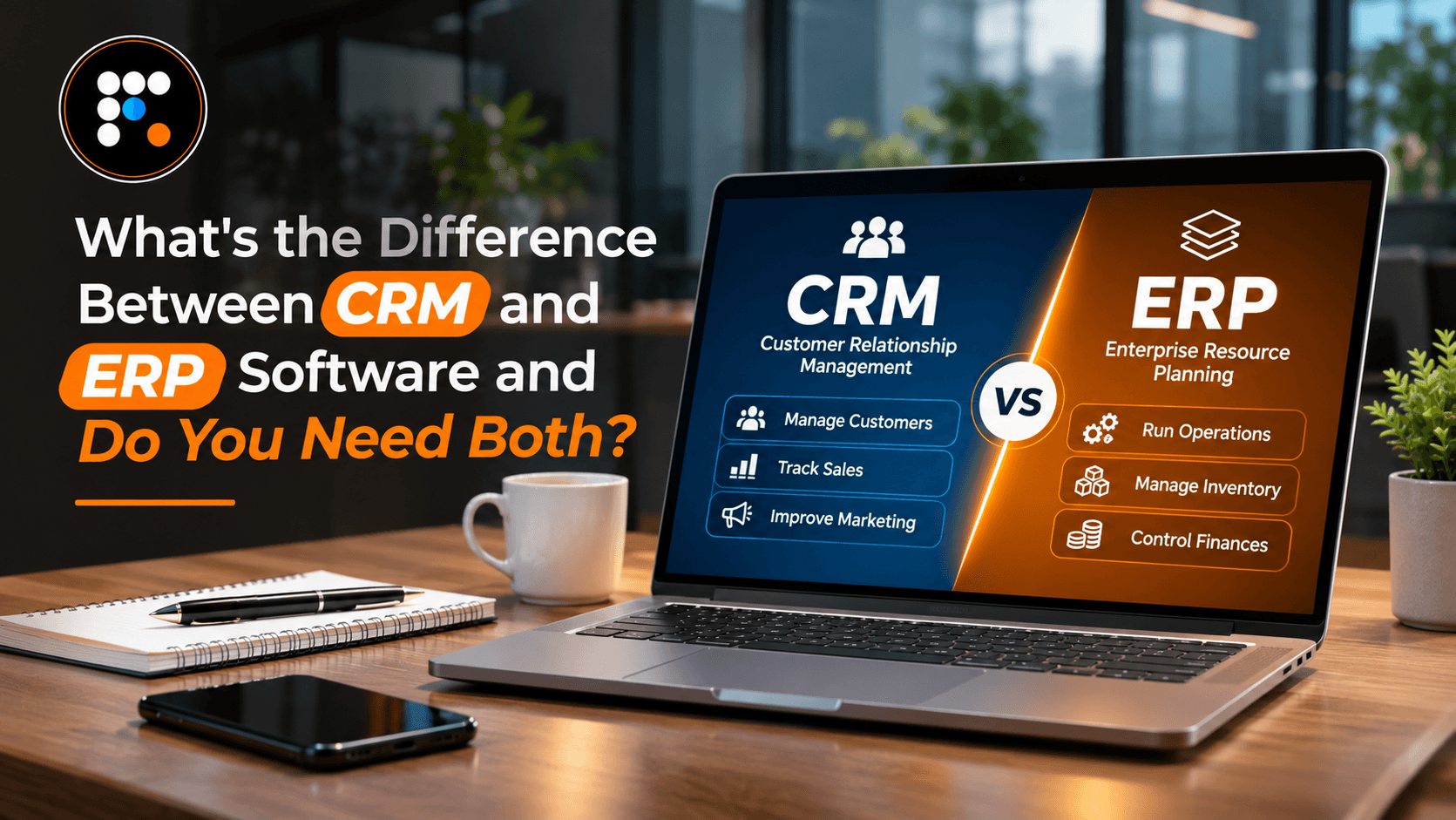
The main difference between CRM and ERP software is the area of business each system primarily supports. CRM focuses on managing relationships with customers, improving sales visibility, and organizing communication. ERP focuses on managing internal resources, transactions, and operational processes. Sales and customer service teams typically rely heavily on CRM, while finance, purchasing, warehouse, and operations teams commonly use ERP. Their information requirements also differ. CRM manages leads, customer interactions, and sales opportunities, whereas ERP handles financial records, inventory movements, supplier transactions, and other operational data. However, these boundaries are not absolute. Some ERP platforms include CRM modules, while certain CRM solutions provide additional business management functionality.
What Are the Main Features and Benefits of a CRM System?
A CRM system offers several capabilities that help businesses organize customer relationships and sales activities. Common features include contact management, lead tracking, sales pipelines, task reminders, communication histories, and performance reporting. These functions allow sales teams to understand which opportunities require attention and which interactions have already taken place. Customer service teams may also use CRM records to review previous conversations and manage support requests. When implemented appropriately, CRM can improve information sharing and reduce the risk of missed follow ups. However, its effectiveness depends on employees maintaining accurate records and consistently using the system. Simply purchasing CRM software does not automatically increase customer satisfaction or sales.
How ERP Software Helps Manage Internal Business Operations
ERP software supports the activities required to operate a business beyond customer relationship management. Accounting modules help manage invoices, payments, and financial records, while inventory applications monitor stock availability and warehouse movements. Procurement features organize purchasing activities and supplier information. Additional modules may support manufacturing, employee management, and project reporting. Because these functions can share information, businesses may reduce duplicate data entry and improve coordination between departments. For example, purchasing records can support inventory planning, while completed orders contribute to financial reporting. However, ERP effectiveness depends on accurate configuration and properly defined workflows. Businesses should choose relevant modules instead of implementing unnecessary functions that increase complexity and costs.
Do Small and Mid Sized Businesses Need CRM, ERP, or Both?
Not every business needs separate CRM and ERP systems. A small service company managing customer inquiries and sales opportunities may benefit from CRM without requiring extensive inventory or procurement functionality. Conversely, a distribution business experiencing stock discrepancies and financial reporting difficulties may need ERP capabilities more urgently. Companies managing complicated customer relationships alongside inventory, purchasing, and accounting may benefit from integrated functionality. The decision should depend on operational complexity rather than employee count alone. Business owners uncertain about the investment can explore Is ERP Software Worth It for Small and Mid-Sized UAE Businesses?. Evaluating existing problems helps determine whether CRM, ERP, or a combination offers the most practical solution.
How CRM and ERP Systems Work Together
When CRM and ERP systems are connected, businesses can coordinate customer facing activities with internal operations. Consider a company receiving an inquiry for a product. The CRM records the customer details and tracks the sales opportunity. Once the order is confirmed, the ERP system can check inventory, manage fulfilment, and process invoicing according to established workflows. Relevant order information may then become available to customer service representatives. This connection can reduce repeated data entry and provide greater visibility across departments. However, successful integration requires compatible systems, accurate data mapping, and appropriate access permissions. Businesses should also remember that some integrated ERP platforms already include CRM functionality, eliminating the need for two completely separate applications.
How Much Does CRM and ERP Software Cost in Dubai?
CRM and ERP software costs vary according to user numbers, required features, subscription plans, and implementation complexity. Basic CRM applications may be relatively inexpensive to adopt, particularly when businesses require straightforward contact management and sales tracking. ERP implementations can involve broader expenses because they often connect several departments and require additional configuration. Businesses may also need to budget for data migration, integrations, customization, employee training, and ongoing support. Advertised subscription fees do not necessarily include these services. A company evaluating software in Dubai should request a detailed quotation covering both initial implementation and recurring expenses. Comparing total ownership costs provides a clearer understanding of the investment than comparing monthly subscription prices alone.
How to Choose the Best CRM Software in Dubai for Your Business
Finding the best CRM software in Dubai depends on the business's specific customer management requirements. Before selecting a platform, identify the information your sales team needs, the channels customers use to communicate, and the reports management expects. Important considerations include lead management, sales automation, mobile accessibility, integration capabilities, and ease of use. Businesses serving multilingual audiences may also need Arabic language support and suitable interface options. Data security, access permissions, and reliable technical support should form part of the evaluation. Instead of selecting software based on popularity or the number of available features, businesses should prioritize functionality that solves existing problems and remains manageable as their requirements change.
Common Mistakes Businesses Make When Choosing CRM and ERP Software
One common mistake is purchasing ERP when the main problem involves managing leads and customer communication. Another is implementing CRM when the business actually needs better inventory control, purchasing coordination, or financial reporting. Companies may also underestimate migration costs, overlook employee training, or purchase unnecessary features that complicate daily operations. Selecting applications without considering their ability to exchange information can create additional problems. Businesses experiencing recurring system limitations should review Signs Your Business Has Outgrown Its Current Tech Setup before committing to new software. Understanding existing weaknesses helps organizations determine whether they need additional CRM functionality, broader ERP capabilities, or improved integration between current applications.
Important Questions to Ask Before Investing in CRM or ERP
Before making a software investment, business owners should identify which operational problems need to be solved and how improvements will be measured. Ask whether existing applications can address those problems without a complete replacement. Determine which departments will use the new system, what information must be transferred, and whether integration with current software is possible. Businesses should also examine implementation timelines, licensing arrangements, maintenance costs, and employee training requirements. For UAE organizations, data protection and applicable financial reporting obligations deserve attention. ERP systems handling invoicing should also be assessed against relevant VAT and electronic invoicing requirements. Clear answers help businesses select a solution that supports practical objectives rather than unnecessary technical complexity.
Conclusion:
Choosing between CRM and ERP software depends on the challenges your business needs to address. CRM software helps organize customer relationships, sales opportunities, and communication, while ERP supports accounting, inventory, purchasing, and other internal operations. Some companies need only one system, while others benefit from integrated functionality that connects customer management with operational processes. The important consideration is whether the selected software solves genuine business problems without introducing unnecessary expenses. Before investing, assess existing workflows, identify information gaps, compare implementation costs, and evaluate integration requirements. The right solution should improve how your business operates today while remaining suitable for its future needs.