








Ten years ago this question would have been easy to dismiss. Today it is not. An AI website builder can now take a two sentence brief and return a complete, responsive, publishable website in about fifteen minutes, with copy, layout and images already in place. The market for these tools reached roughly 6.3 billion dollars in 2026, a 26 percent jump on the previous year, with small and medium businesses making up around 63 percent of users. That is not a passing trend. So the honest version of this question is not whether AI builders work. It is whether they hold up once your website has to earn money, rank in search, handle real customers and survive two years of growth. The answer depends almost entirely on what you are building and where you are building it.
What an AI Website Builder Actually Does Well
Let us give the technology its due, because most comparison articles do not. An AI website builder removes the three things that historically stopped businesses from launching at all: cost, time and technical confidence. The learning curve for a first time user has collapsed from a full working day down to roughly fifteen minutes. On Wix alone, more than half of all new users now begin with AI powered setup rather than a blank template. For a freelancer validating a service idea, a restaurant that needs a menu and a booking link, or a startup testing whether anyone wants the product at all, that speed is genuinely valuable. You get a live, indexable presence for the price of a monthly subscription, you can change your mind on Tuesday, and you have not committed capital to something unproven. If your website is a business card rather than a business asset, an AI builder is often the correct and rational choice.
Where AI Website Builders Start to Break Down
The problems rarely appear in month one. They appear in month eight, when traffic plateaus, when a competitor outranks you, or when you need the site to do something the platform never anticipated.
SEO, Page Speed and Core Web Vitals
The most accurate summary from independent testing across 2026 is this: most AI builders are SEO safe, but very few are SEO strong. The recurring gaps are limited control over URL structures, schema markup and crawl optimisation, thin pattern based copy, and weak or absent content management for blogging. These are precisely the levers that decide competitive rankings. Performance compounds the issue. Vodafone ran a controlled test where the only variable was a 31 percent improvement in Largest Contentful Paint and recorded an 8 percent increase in sales, while Rakuten 24 measured 53.37 percent more revenue per visitor after Core Web Vitals work. Only about 48 percent of sites currently pass Core Web Vitals on mobile, which means passing is a competitive advantage rather than a baseline. Builders that generate generic markup and load scripts you did not ask for make that advantage much harder to reach. Google's own 2026 guidance is blunt that optimising for generative AI search is still SEO, so the technical foundation matters more now, not less.
Customisation, Integrations and Who Owns the Code
The second limitation is structural. Many AI builders run on proprietary rendering engines, meaning the code structure is decided by the platform and cannot be exported. Your content and your rankings end up living on infrastructure you cannot fully control or migrate cleanly. That becomes expensive the day you need a custom booking flow, a CRM sync, a multi currency checkout or an Arabic version that behaves properly in right to left layout. There is also a security dimension that very few business owners factor in. Veracode testing across more than 100 models found that 45 percent of AI generated code samples introduce OWASP Top 10 vulnerabilities, a failure rate that did not improve across testing cycles from 2025 into early 2026. A scan of 1,400 applications built on AI first platforms uncovered 2,038 highly critical vulnerabilities, more than 400 leaked secrets and 175 instances of exposed personal data including financial and medical records. Generated code is fast. It is not automatically safe code.
What You Are Really Paying for With Professional Web Development
When businesses compare a monthly subscription against a development quote, they are usually comparing the wrong two things. The subscription buys you a published page. Professional development buys you decisions. It buys an information architecture built around how your customers actually search, a keyword and content structure designed before a single pixel is placed, schema markup that earns rich results, a performance budget enforced during the build rather than patched afterwards, accessibility, security review, analytics that attribute revenue properly, and a migration path if you outgrow the stack. It also buys accountability, which no platform provides. A useful way to run the numbers is total cost of ownership: a low cost builder that needs a few hundred dollars a month in plugins to compete is not genuinely cheaper than a custom build with minimal ongoing hosting costs. Over a three year horizon, the gap often closes or reverses entirely.
Why Your Market Changes the Answer?
Geography changes this calculation more than most people expect, and the UAE is a clear example. The national e commerce market reached 12.30 billion dollars in 2026 and is forecast to climb to 21.01 billion by 2031, with Dubai claiming roughly 60 percent of that activity. Internet penetration sits near 99 percent across approximately 11.3 million users. That is a mature, crowded, high expectation market where generic output is immediately visible as generic. Localisation is the sharpest example. Around 60 percent of online shoppers in the UAE prefer to browse in Arabic, and a properly localised experience can lift conversion meaningfully. Templated right to left support rarely survives contact with real content. Compliance is the second example. The UAE Personal Data Protection Law applies extraterritorially, carries consent and cross border transfer requirements, and expects Arabic language privacy disclosures for consumer facing services targeting UAE residents. An auto generated policy page does not cover that. This is a large part of Why Your Business Needs a Local Web Development Company in UAE rather than a platform that has never heard of the Data Office.
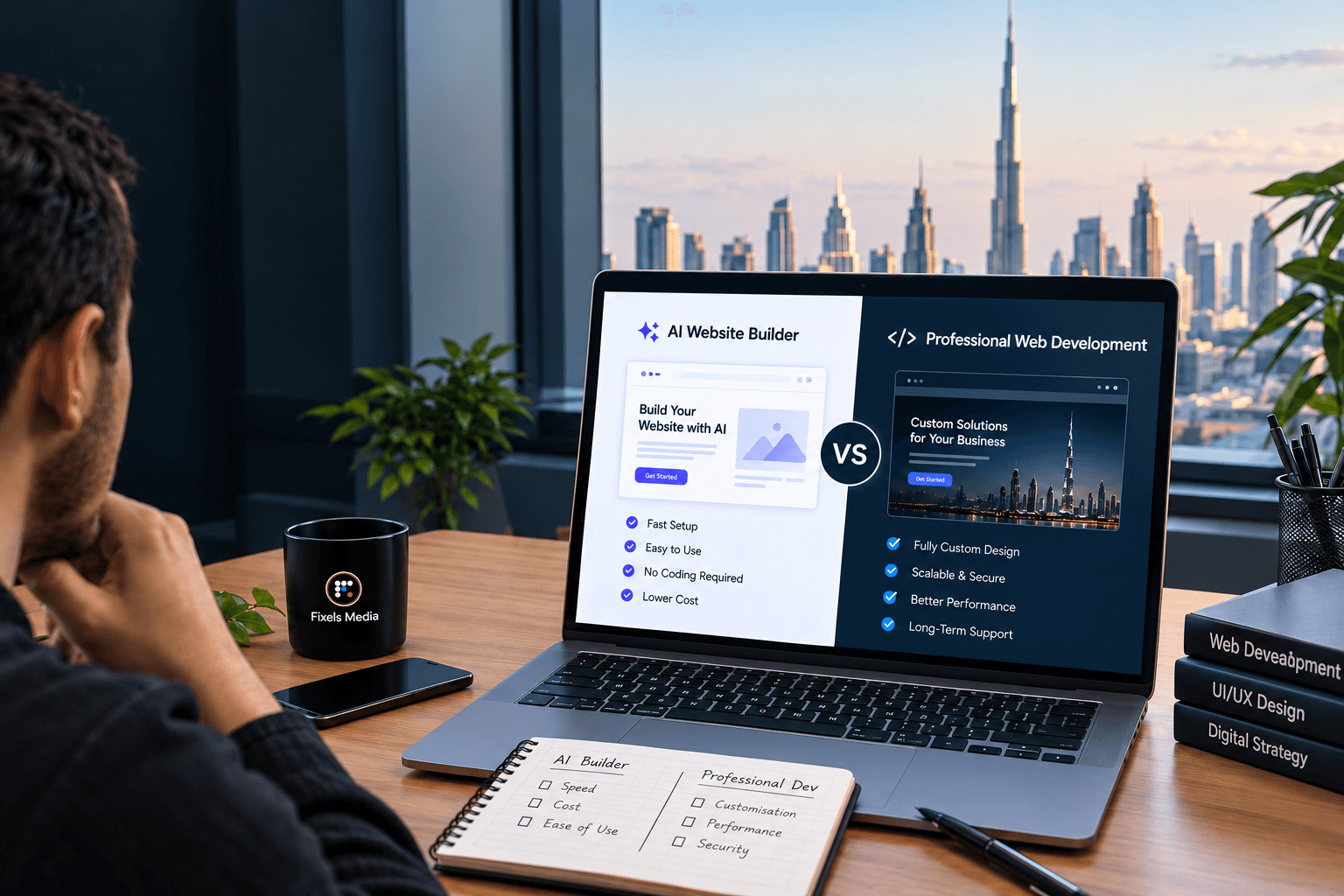
AI Website Builder vs Professional Development: A Side by Side Look
Here is the realistic comparison, stripped of marketing on both sides.
Time to launch: AI builder measured in hours. Professional build measured in weeks.
Upfront cost: AI builder is a modest monthly subscription. In Dubai, a basic professional business site typically runs from AED 3,500 to 8,000, a corporate site from AED 12,000 to 55,000, and custom platforms from AED 50,000 upward.
SEO ceiling: Builders rank well for brand terms and low competition local queries. Competitive commercial keywords require the technical control builders restrict.
Scalability: Builders handle brochure sites comfortably and struggle with custom logic, integrations and multilingual depth.
Ownership: With most builders you rent. With custom development you own the codebase and can move it.
Support: A ticket queue versus a named team that knows your business.
The Hybrid Approach: Using AI Without Betting Your Business on It
The smartest operators are not choosing a side. They are sequencing. Use an AI website builder to validate positioning, test messaging and capture early leads while the offer is still moving. Treat that site as a disposable experiment, not a foundation, and keep your content, assets and domain fully portable from day one. Once the model is proven and the site is carrying real revenue, rebuild deliberately on a stack you control, carrying across what the experiment taught you about which pages convert. Professional teams also use AI internally, for first draft layouts, boilerplate code and content scaffolding, then apply human review for performance, security, accessibility and search. The difference is not whether AI is used. It is whether anyone qualified checks the output before customers do.
So Which One Is Actually Better for You?
If you are pre revenue, testing an idea, or need a simple presence that will never carry complex functionality, an AI builder is better, and paying for custom development would be waste. If search traffic is a meaningful acquisition channel, if you sell online, if you handle customer data, if you operate in Arabic and English, or if your website is expected to generate leads rather than merely exist, professional development wins on every measure that compounds over time. The question is not which tool is more advanced. It is which one matches the job your website has to do. Anyone evaluating a Web Development Company should ask how they approach performance budgets, schema, localisation and compliance, because those answers separate a real partner from a template vendor. That is the standard we hold ourselves to at Fixels Media.
Conclusion
AI website builders have not replaced professional web development. They have replaced the bottom of the market, which badly needed replacing, and in doing so they have raised the bar for what professional work must justify. A builder gets you online. A properly engineered website gets you found, trusted, converted and compliant in a market as competitive as the UAE. Choose the builder when speed and validation matter most. Choose a serious team when the website becomes infrastructure your revenue depends on. The businesses that struggle are the ones that pick the first option and then expect the second option's results, usually a year later, after the rankings and the rebuild costs have already stacked up.