







Most business owners in Dubai do not need a technical education before commissioning an app. They need a clear picture of what the process involves, what it costs, what can go wrong, and where their own decisions matter most. That is what this guide provides. Whether you are evaluating a Mobile App Development Company for the first time or revisiting a project that stalled, the sections below walk through app development Dubai from first principles to post launch reality. The aim is not to make you an engineer. It is to make you a confident client who asks the right questions at the right moment.
Why Dubai Has Become a Serious App Market
The commercial case here is stronger than in most cities of comparable size. The UAE mobile application market is projected to reach USD 2.36 billion by 2030, growing at 10.3% annually, with Dubai holding the largest share thanks to its dense urban population and high disposable income.
Consumer behaviour backs that up. In 2025, 78.67% of UAE e-commerce transactions originated on mobile, and smartphone-channel e-commerce is expected to exceed USD 15 billion by 2031.
Government policy points the same way. The D33 agenda targets new economic value from digital transformation averaging AED 100 billion each year, while national plans aim to lift the digital economy’s contribution to UAE GDP from 9.7% to more than 20% by 2031. For business owners, this means an audience already comfortable transacting on mobile.
Deciding Whether You Actually Need an App
Not every business needs a native app, and a good partner will tell you so before taking your money.
An app earns its place when you need repeat engagement, offline functionality, push notifications, device hardware access such as camera or GPS, or a loyalty relationship with returning users. If your customers visit once a quarter to check a price or place a single order, a fast mobile optimised website or a progressive web app will usually serve them better at a fraction of the cost.
Ask yourself one practical question: what will make someone keep your app installed after the first week? If the honest answer is nothing, redirect that budget into your website and acquisition instead. Clarity at this stage saves far more money than any discount a vendor will offer you later.
Choosing Your Platform and Technology Approach
Your platform decision shapes cost, timeline and maintenance for years, so it deserves proper thought rather than a default.
Native development means separate codebases for iOS and Android. It delivers the deepest performance and the tightest access to device features, but you build and maintain two products instead of one.
Cross platform development using frameworks such as React Native or Flutter consolidates most of your code into a single codebase. It lowers build cost and long term maintenance effort, and for the majority of business applications the performance difference is no longer meaningful.
The practical approach for most Dubai businesses is cross platform first, moving to native only where a specific feature genuinely demands it. Discuss this openly with your developer and ask them to justify their recommendation against your actual feature list rather than their internal preference.
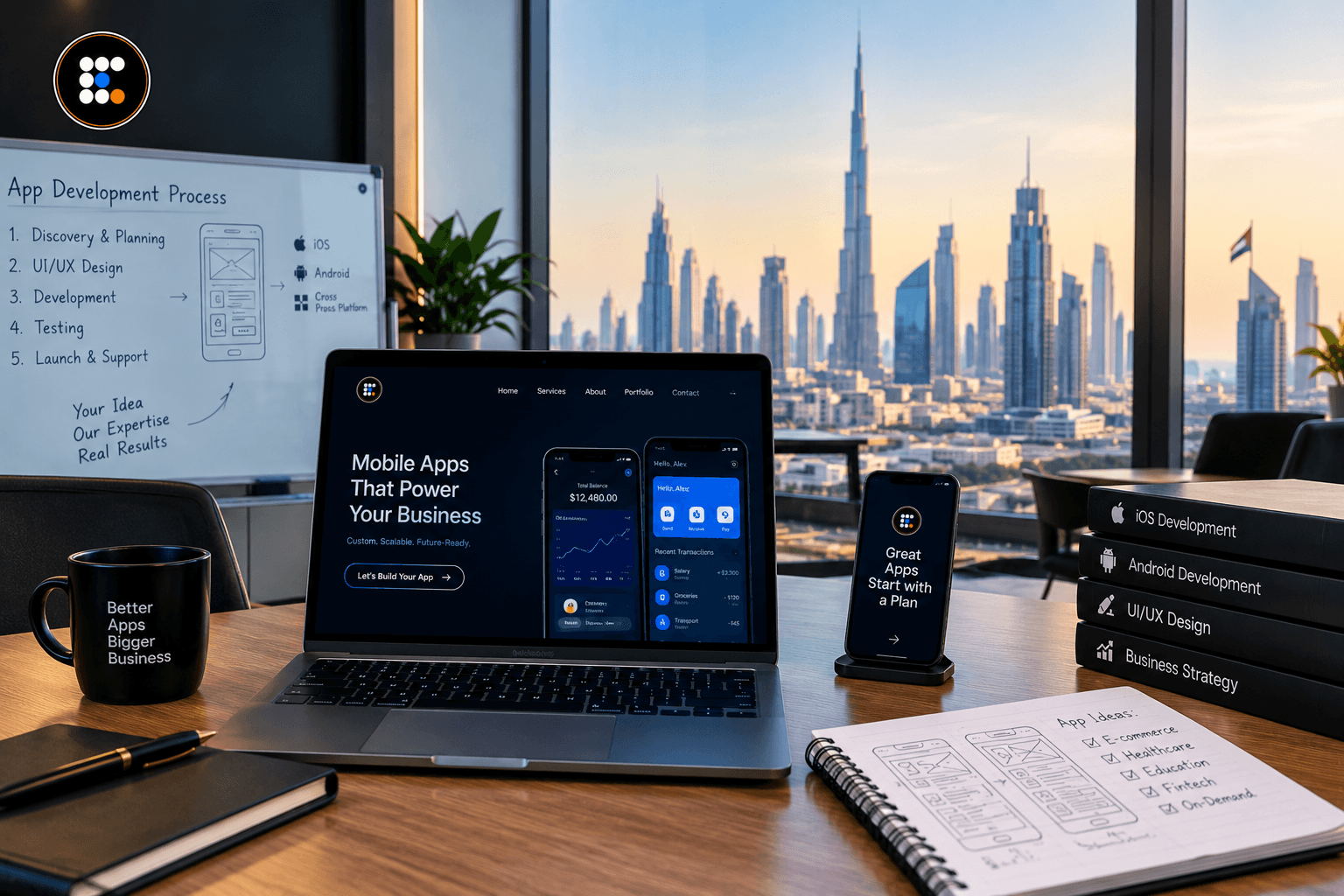
The App Development Process From Idea to Launch
Typical projects run three to nine months end to end, depending on complexity.
Discovery and scoping comes first, usually two to five weeks alongside design. This is where user journeys, features and technical architecture are agreed. It typically consumes 10 to 15% of your budget, and skipping it is the single most common cause of cost overruns.
Design and prototyping turns the scope into wireframes and clickable prototypes. Review these carefully, because changing a screen here costs almost nothing compared with changing it after development.
Development and testing is the longest phase, running three to nine months and consuming 40 to 55% of the total budget. Quality assurance should run alongside development rather than being left to the end.
Launch and store approval follows. Apple App Store reviews are generally stricter and slower than Google’s, so build buffer time into your launch plan rather than announcing a fixed public date early.
Understanding What App Development in Dubai Costs
Published benchmarks place mobile app development Dubai between roughly AED 25,000 for a basic application and more than AED 500,000 for complex multi platform products. Simple apps commonly land between AED 25,000 and AED 80,000, while complex builds run from around AED 80,600 into AED 200,000 and beyond.
Those ranges are wide because the variables are wide. Feature count, number of third party integrations, design customisation, backend complexity, security requirements and team location all move the figure.
What matters more than the headline number is how it is broken down. Insist on a quotation split across discovery, design, frontend, backend, integrations, testing, deployment and support. Then ask explicitly what is excluded, because cloud hosting, third party licences, store developer accounts and content population are routinely left out of initial proposals.
Building for a Bilingual Market
Arabic and English support is not a translation task. It is an engineering requirement.
Right to left layouts affect navigation direction, icon placement, text alignment, form behaviour and typography. Dates, numerals and currency formatting all need handling. Dynamic content pulled from your backend must support both languages cleanly.
Teams that treat bilingual support as a late stage add-on usually end up rebuilding screens. Specify it in your original scope, budget for it properly, and ask to see an existing bilingual app the team has shipped so you can test the Arabic experience yourself rather than taking it on trust.
Local Integrations Dubai Apps Usually Need
Applications built for this market rarely work in isolation. Many require identity verification through UAE PASS, which has its own documented mobile integration requirements, SDK and staging environment for proof of concept work. Payment flows generally run through Telr, Network International, CCAvenue or Stripe, and 3-D Secure is required for most online card transactions in the UAE to meet local regulations. Delivery and logistics apps often need mapping, courier APIs and real time tracking.
Each integration adds development time and testing cycles. When reviewing proposals, ask which of these a team has actually shipped to production and request the app name so you can verify it independently.
Legal and Compliance Obligations You Cannot Skip
Compliance is where inexperienced vendors cost their clients the most. Federal Decree-Law No. 45 of 2021, the UAE Personal Data Protection Law, applies to mainland companies and most free zone companies, with DIFC and ADGM under separate regimes. It requires explicit, unambiguous consent obtained through a clear affirmative action, grants users rights including erasure, and imposes breach notification, data protection impact assessments and cross border transfer safeguards. Large scale data handlers must appoint a Data Protection Officer. The UAE Data Office regulates it.
Sector rules sit on top of that. Healthcare apps need Dubai Health Authority approval, typically a four to eight week process, plus NABIDH integration, and HIPAA compliance alone does not satisfy DHA requirements. Virtual asset businesses must be licensed by VARA through a structured two stage process. Identify your sector gate before development begins, not after.
Choosing Your Development Partner
Verify the trade licence first. Mainland companies can be checked through Invest in Dubai or DET e-services, while free zone firms are verified through their own authority portals. Confirm the registered activity actually covers IT or software consultancy.
Then test capability rather than presentation. Ask about testing practices, release processes and the hardest problem they solved recently. Speak to an engineer, not only an account manager. For a deeper evaluation framework, this guide on How to Choose the Right App Development Company in Dubai expands the criteria considerably.
Agencies such as Fixels Media that work across both UAE and wider regional markets can often supply cross market delivery references, which are worth requesting. Finally, settle ownership of source code, repositories, cloud accounts and store listings in writing before signing.
What Happens After Launch
Launch is a milestone, not a finish line. Budget 15 to 25% of your original build cost annually for maintenance, covering operating system updates, security patches, bug fixes and small improvements.
Beyond upkeep, instrument the app properly from day one. Track activation, retention, session frequency and whichever conversion event actually represents revenue for your business. Download counts tell you almost nothing on their own.
Plan your first post launch iteration before you launch. Real user behaviour will contradict at least some of your assumptions, and the businesses that win are the ones with budget and appetite remaining to act on what they learn in the first ninety days.
Common Mistakes Business Owners Make
Four mistakes account for most failed projects. Approving a vague scope and then adding features mid build. Choosing a vendor purely on price without comparing what each quotation actually includes. Treating Arabic support and compliance as afterthoughts. And spending the entire budget on version one with nothing left for iteration.
Avoiding all four costs nothing. It simply requires decisions to be made before development starts rather than during it.
Final Thoughts
Application development Dubai rewards preparation more than budget. Define the problem clearly, choose a technology approach that matches your actual requirements, verify your partner properly, plan compliance early, and keep funds in reserve for the months after launch. Business owners who follow that sequence rarely end up with the expensive disappointments that give the industry its reputation.